In supporting the industries and economies in the Tropics, our faculty often provides their thought leadership. Our faculty’s research provides new insights on key topics relevant for industries and economies in the Tropics, see featured articles around halal service quality, animal care, and green banking published by business school academics of James Cook University in Singapore.
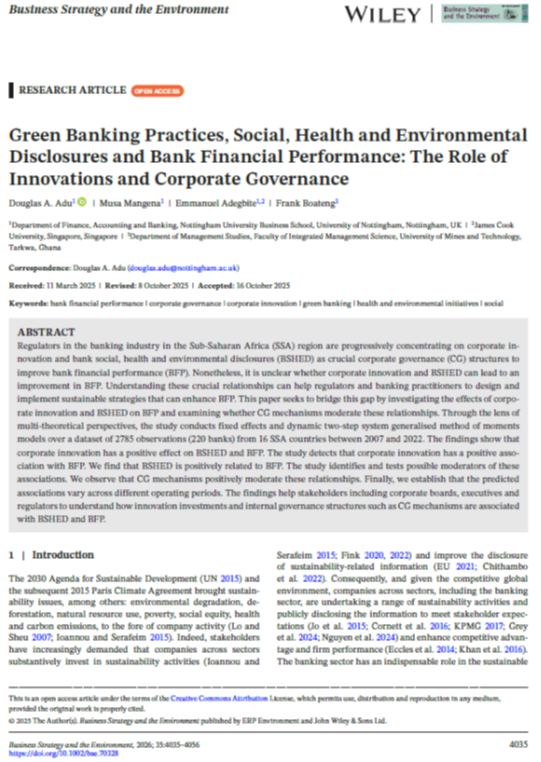
Halal service quality: systematic review, conceptual model and future research
Journal of Islamic Accounting and Business Research, 2025
Service quality is an established research area in the services marketing literature and is an integral component in an Islamic economy driven by halal service sectors. Despite its importance and the rapidly changing service environment, there has yet to be a comprehensive study of service quality research across halal industries. The purpose of this study is to systematically review the existing literature on service quality in halal industries to provide a state-of-the-art understanding and identify opportunities in this research area. Guided by the Scientific Procedures and Rationales for Systematic Literature Reviews (SPAR-4-SLR) protocol and the theories, contexts, characteristics and methods (TCCM) framework, this paper reviews 78 journal articles from the Web of Science database which features service quality as an underpinning theory in the context of halal economies. Findings indicate that since the first study in 2010, service quality research in halal industries has concentrated on consumers in the Islamic finance sector who are served primarily by human service agents. Most studies are focused on halal industries in Muslim countries. Several papers adopt the SERVQUAL model while others develop more novel service quality scales for halal industries. Culture, technology and faith-related factors are key drivers of halal service quality. While few papers study the antecedents and moderators of service quality in halal industries, religiosity was found to be a significant variable in several papers reviewed. The global Islamic economy will continue to be driven by halal services. This review will provide managers with an appreciation of service quality across different halal industries. Researchers can use the results of this review to guide future studies and contribute toward the development of this research area.
Available at: https://doi.org/10.1108/JIABR-06-2024-0211
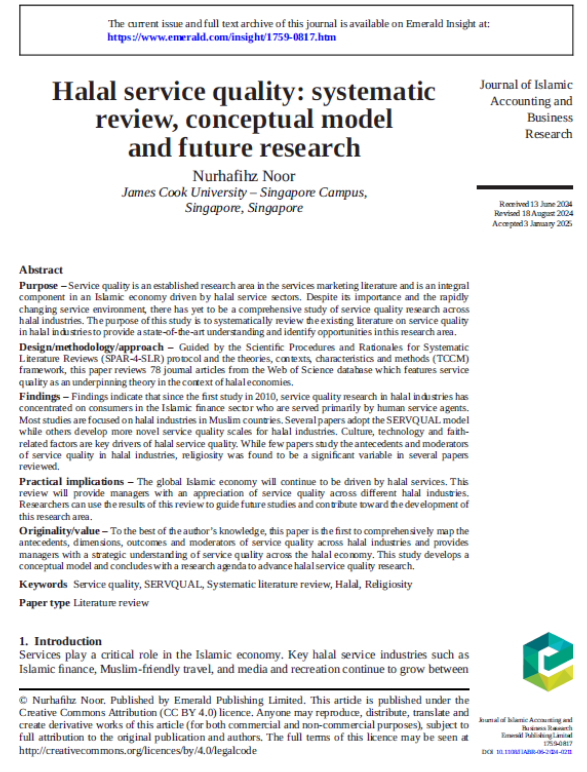
Enhancing animal care through digital tools: a challenge and hindrance perspective of technology adoption in a zoological institution
Behaviour and Information Technology, 2025
The adoption of digital technologies in zoological institutions is transforming animal care management. However, challenges persist in integrating mobile applications into daily workflows. This qualitative study examines technology adoption in a Southeast Asian zoological institution, focusing on a mobile application designed for animal care. Using the Technology-Organisation-Environment framework and the challenge-hindrance perspective, we conducted four focus group interviews with 21 users to explore the factors influencing adoption, including perceived usefulness, ease of use, organisational support, and environmental pressures. Findings reveal that while the Application enhances efficiency, collaboration, and animal welfare, fostering a challenge appraisal and voluntary adoption, barriers such as usability issues, security fatigue, and interoperability contribute to a hindrance appraisal and involuntary adoption. Organisational support, including onboarding, co-creation, and technical assistance, is crucial in mitigating the hindrance appraisal and resistance. The study contributes to a holistic adoption framework, offering practical insights for designing and implementing digital tools in specialised work environments, ultimately enhancing technology-driven wildlife management and conservation efforts.
Available at: https://doi.org/10.1080/0144929X.2025.2542406
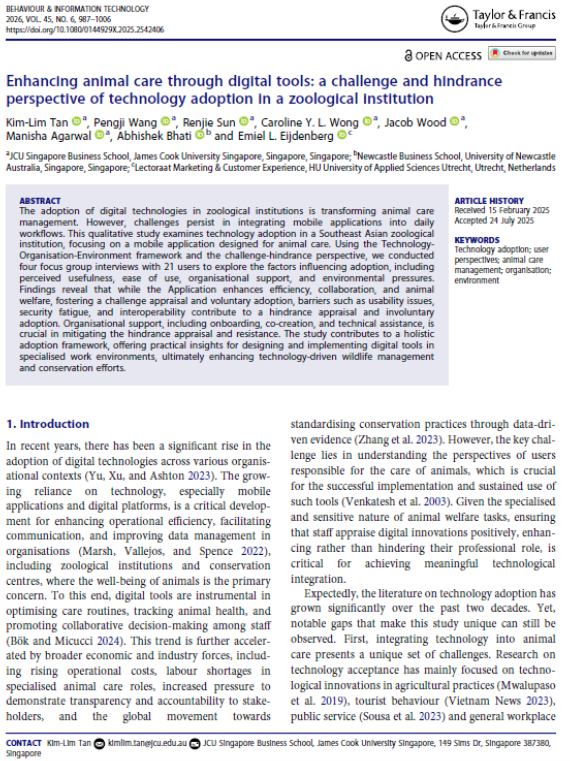
Green Banking Practices, Social, Health and Environmental Disclosures and Bank Financial Performance: The Role of Innovations and Corporate Governance
Business Strategy and the Environment, 2026
Regulators in the banking industry in the Sub-Saharan Africa (SSA) region are progressively concentrating on corporate innovation and bank social, health and environmental disclosures (BSHED) as crucial corporate governance (CG) structures to improve bank financial performance (BFP). Nonetheless, it is unclear whether corporate innovation and BSHED can lead to an improvement in BFP. Understanding these crucial relationships can help regulators and banking practitioners to design and implement sustainable strategies that can enhance BFP. This paper seeks to bridge this gap by investigating the effects of corporate innovation and BSHED on BFP and examining whether CG mechanisms moderate these relationships. Through the lens of multi-theoretical perspectives, the study conducts fixed effects and dynamic two-step system generalised method of moments models over a dataset of 2785 observations (220 banks) from 16 SSA countries between 2007 and 2022. The findings show that corporate innovation has a positive effect on BSHED and BFP. The study detects that corporate innovation has a positive association with BFP. We find that BSHED is positively related to BFP. The study identifies and tests possible moderators of these associations. We observe that CG mechanisms positively moderate these relationships. Finally, we establish that the predicted associations vary across different operating periods. The findings help stakeholders including corporate boards, executives and regulators to understand how innovation investments and internal governance structures such as CG mechanisms are associated with BSHED and BFP.
Available at: https://onlinelibrary.wiley.com/doi/epdf/10.1002/bse.70328