Our focus on research relevant for the tropics is reflected in our leading role in the Journal of tropical futures. The journal publishes research highlighting sustainable business, governance and development in the tropics and its editorial office is located at James Cook University Singapore. See the editorial update below. The two other papers feature research on environmental issues and climate change in leading journals ranked A* in the Australian journal ranking ABDC list.
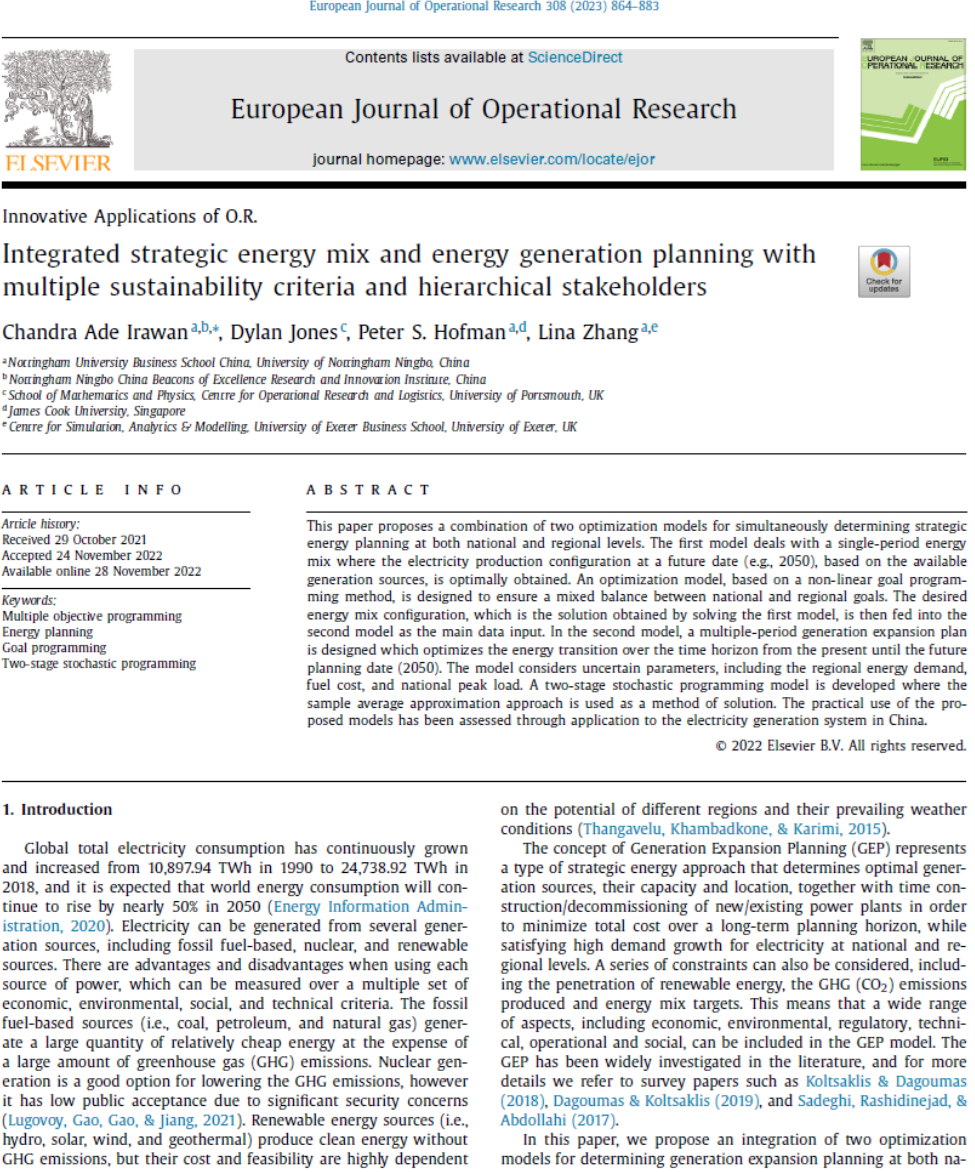
Journal of tropical futures editorial update: Rethinking tropical futures – towards sustainable systems of justice, care and regeneration
Journal of Tropical Futures, 2026
Nearly three years after its inception, the Journal of Tropical Futures (JTF) continues to evolve. When the journal was officially launched in 2022, it sought to highlight the significance of tropical regions for questions of sustainable business, governance, and development (Case et al., 2022). Today, as the world faces accelerating ecological crises, widening inequalities, and shifting geopolitical realities, the need for a systemic and plural rethinking of sustainability has never been greater. The tropics – home to over 3.8 billion people and more than 80% of global biodiversity (State of the Tropics Report, 2020) – remain at the forefront of these transitions. Far from being merely sites of environmental or developmental challenge, tropical regions represent critical laboratories of innovation, resilience, and epistemic diversity. They are places where alternative modes of living, governing, and knowing are constantly being experimented with – offering insights into how humanity might reimagine its collective futures. As we enter this new phase, JTF reaffirms its role as a forum for substantive research and knowledge at the intersections between disciplines (and beyond them) about the relationships between humanity and its possible futures. The journal retains its commitment to analyze and challenge misuses and abuses of futures – such as those embodied in planetary resource overshoot (Rockström et al., 2025) – while advancing a robust understanding of the conditions needed to create emancipatory, socially responsible, and ecologically just futures. In doing so, it pays particular attention to the developmental opportunities and systemic challenges emerging from the tropics, recognizing these regions as crucial sites for reimagining sustainability beyond the confines of capitalist domination and the logics of endless growth.
Available at: https://doi.org/10.1177/27538931251408053
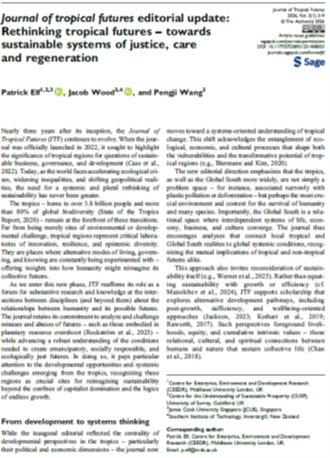
Guiding pro-environmental behaviour: examining the impact of cognitive and behavioural interventions on sustainable food choices in hospitality
Journal of Sustainable Tourism, 2026
Food consumption represents a substantial share of tourism’s global CO2 emissions. Yet, experimental research on reducing high-emission food choices among tourists is scarce. This study explores how cognitive and behavioural interventions affect the likelihood of choosing vegetarian dishes in hotel restaurants. The authors conducted covert field experiments using theory-informed menu designs to encourage vegetarian food choices. In two hotels, 647 participants received one of four menu conditions: the hotel’s default menu or one of three intervention menus. The intervention menus were designed to test cognitive (using the bandwagon effect) or behavioural interventions (using framing and anchoring biases). The results show that the behavioural interventions outperformed the cognitive intervention in increasing vegetarian orders. When presented with the behavioural intervention, participants had up to 654% (95% CI [2.21, 49.80]) higher odds of choosing vegetarian dishes than the cognitive intervention group. The odds increased to 950% (95% CI [1.26, 27.35]) when the participants were presented with a framing and anchoring-based behavioural intervention. The results indicate that behavioural interventions are more effective in encouraging pro-environmental food choices in hotel settings than cognitive interventions. This study contributes to the literature on pro-environmental behaviour change, presenting suggestions for further studies and practical, theoretical, and managerial implications.
Available at: https://www.tandfonline.com/doi/full/10.1080/09669582.2024.2439983
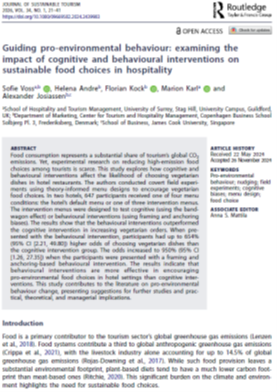
Integrated strategic energy mix and energy generation planning with multiple sustainability criteria and hierarchical stakeholders
European Journal of Operational Research, 2023
This paper proposes a combination of two optimization models for simultaneously determining strategic energy planning at both national and regional levels. The first model deals with a single-period energy mix where the electricity production configuration at a future date (e.g., 2050), based on the available generation sources, is optimally obtained. An optimization model, based on a non-linear goal programming method, is designed to ensure a mixed balance between national and regional goals. The desired energy mix configuration, which is the solution obtained by solving the first model, is then fed into the second model as the main data input. In the second model, a multiple-period generation expansion plan is designed which optimizes the energy transition over the time horizon from the present until the future planning date (2050). The model considers uncertain parameters, including the regional energy demand, fuel cost, and national peak load. A two-stage stochastic programming model is developed where the sample average approximation approach is used as a method of solution. The practical use of the proposed models has been assessed through application to the electricity generation system in China.
Available at: https://www.sciencedirect.com/science/article/pii/S0377221722009183