Many of our Business School faculty’s expertise resides in areas supporting people and societies in the Tropics. They feature topics such as digitalization and memory-making, education and adult learning, and corporate social responsibility. See a selection of influential research papers below.
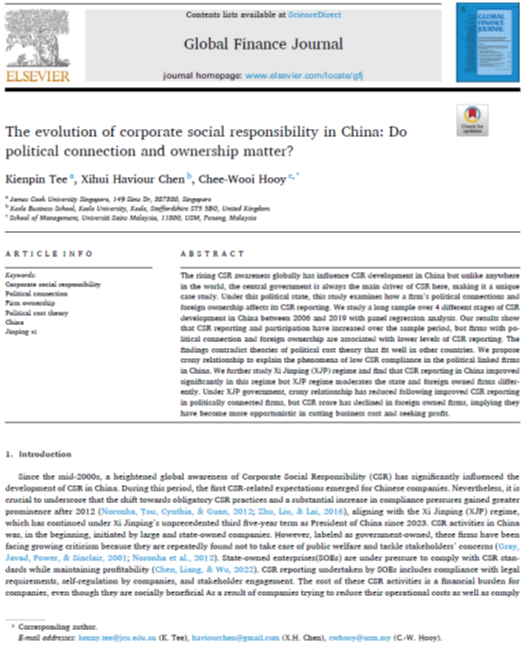
The impact of digitalisation and digitisation in museums on memory-making
Current Issues in Tourism, 2024
Museums have expanded beyond their initial role in preserving artefacts as memory intuitions, playing an educational role and being tourist attractions. They had to adapt and increasingly utilise digital technologies to stay relevant in contemporary times. The use of technology in museums can be divided into two domains: digitalisation and digitisation. This study reviews 83 screened articles aligning with the guidelines of PRISMA systematic review to analyse existing knowledge about digitalisation and digitisation in museums, to demonstrate how these processes impact the role of museums, memory-making, and identify gaps for further research. The results indicate that digitalisation and digitisation enhance the overall museum experience for museum visitors and promote the educational aspect of museums as an ‘interconnected space’. Notable use of digitalisation includes the use of Virtual Reality and Augmented Reality, while digitisation often is present through museum websites. Nonetheless, four current challenges for museums have been identified that warrant further research.
Available at: https://doi.org/10.1080/13683500.2024.2317912
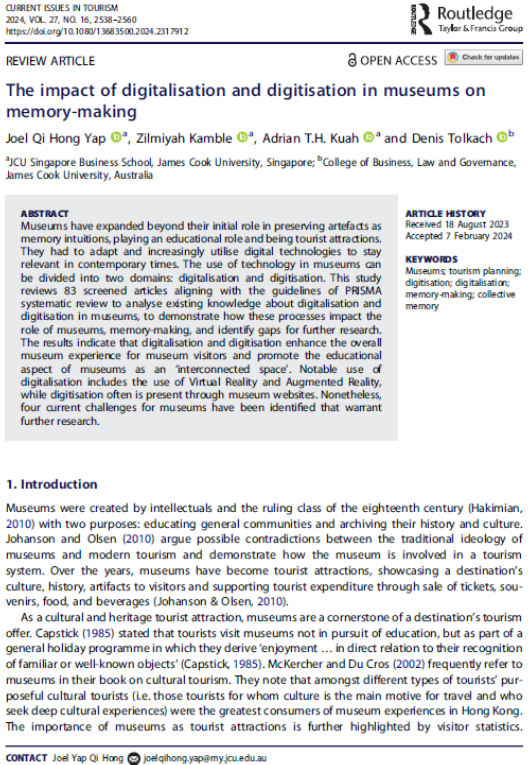
Embracing imperfections: a predictive analysis of factors alleviating adult learners’ digital learning stress on Singapore’s lifelong learning journey
Human Resource Development International, 2025
This research paper examines the intersection of self-determination theory and its constructs of autonomy, competence and relatedness with the effects of learning support levers available to online educators. The learning support levers of social, technical and financial support are considered against their ability to impact online learning satisfaction and overall digital well-being. In surveying 246 adult learners, the research analysis uses structural equation modelling to yield results that highlight the opportunity for suitably planned social and technical support design to enhance the effectiveness of online teaching and learning. The overall findings add to understanding in the domain of digital learning effectiveness and possible strategies for improving online teaching and learning instructional design, including the surrounding environmental support variables. The paper further highlights the benefits of a cross domain approach to exploring learning effectiveness goals in a digital context. Given the increased prevalence of online education, the methodology and resultant findings of this paper are novel, reflecting the lack of research in the digital learning domain.
Available at: https://doi.org/10.1080/13678868.2024.2389029
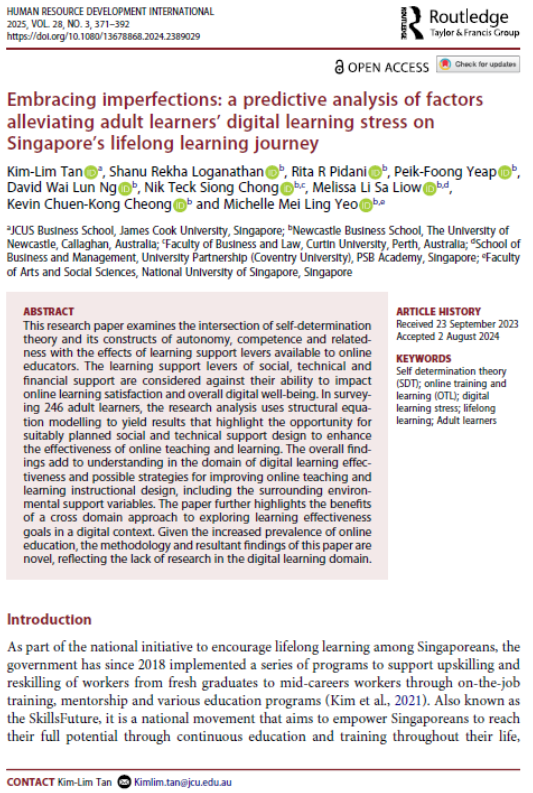
The evolution of corporate social responsibility in China: Do political connection and ownership matter?
Global Finance Journal, 2024
The rising CSR awareness globally has influence CSR development in China but unlike anywhere in the world, the central government is always the main driver of CSR here, making it a unique case study. Under this political state, this study examines how a firm's political connections and foreign ownership affects its CSR reporting. We study a long sample over 4 different stages of CSR development in China between 2006 and 2019 with panel regression analysis. Our results show that CSR reporting and participation have increased over the sample period, but firms with political connection and foreign ownership are associated with lower levels of CSR reporting. The findings contradict theories of political cost theory that fit well in other countries. We propose crony relationship to explain the phenomena of low CSR compliance in the political linked firms in China. We further study Xi Jinping (XJP) regime and find that CSR reporting in China improved significantly in this regime but XJP regime moderates the state and foreign owned firms differently. Under XJP government, crony relationship has reduced following improved CSR reporting in politically connected firms, but CSR score has declined in foreign owned firms, implying they have become more opportunistic in cutting business cost and seeking profit.
Available at: https://doi.org/10.1016/j.gfj.2024.100941