Technology changes quickly. Tools evolve, industries shift, and entirely new roles can emerge within a few years. That is why students today are not just choosing a degree based on a job title – they are also thinking about adaptability, long-term relevance, and whether a program can prepare them for a changing tech landscape.
Quick Answer: “What should students look for in an IT degree today?”
As technology continues to evolve, many students are looking for IT degrees that combine technical foundations with adaptable, future-focused skills. In Singapore, students can choose from a range of pathways, including internationally awarded programs offered through local campuses. At JCU
inSingapore, the Bachelor of Information Technology program at Singapore campus of James Cook University is conditionally accredited by the Australian Computer Society (ACS). In addition the new Masters in Information Technology and Bachelor of Cybersecurity programs are conditionally provisionally accredited.
You’re thinking about an IT career. But more importantly, you’re probably thinking about what kind of skills will still matter five or 10 years from now.
Technology changes quickly. Tools evolve, industries shift, and entirely new roles can emerge within a few years. That is why students today are not just choosing a degree based on a job title – they are also thinking about adaptability, long-term relevance, and whether a program can prepare them for a changing tech landscape.
And in Singapore’s job market, the program you choose – its curriculum, academic framework, and industry alignment – can influence both your learning experience and the kinds of opportunities you may be exposed to later on.
At the same time, students today are navigating a wider range of education pathways. Local universities, international branch campuses, private institutions, online certifications, and bootcamps all offer different approaches to tech education.
This guide looks at what students should consider when evaluating an IT degree today, how future-focused skills are being integrated into IT education, and the different study pathways available in Singapore.
Why the Standard Behind Your IT Degree Still Matters
In Singapore’s tech sector, the combination of formal training and practical skills can influence how graduates adapt to changing industry demands over time.
A portfolio can help you get noticed. Technical ability matters once you’re on the job. But employers also look at how students were trained, the breadth of their curriculum, and whether their learning goes beyond a single technical tool or platform.
That matters because the industry itself is evolving. Areas like artificial intelligence, cybersecurity, cloud systems, automation, and data analytics are increasingly interconnected, which means graduates are expected to combine technical knowledge with problem-solving, communication, and adaptability.
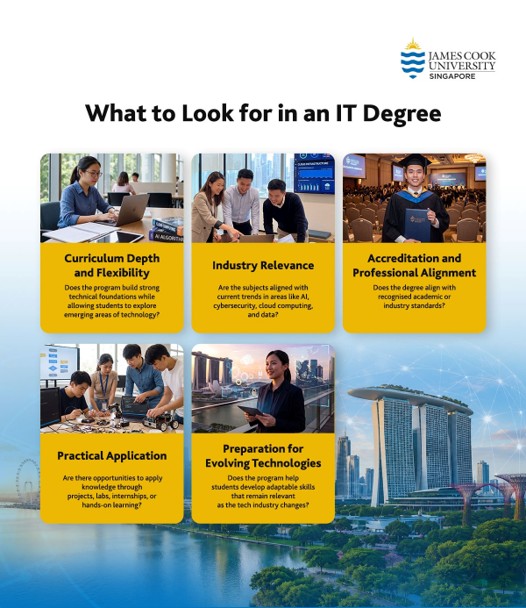
As such, it can be useful to evaluate IT degrees in terms of:
- curriculum depth and flexibility
- industry relevance
- accreditation and professional alignment
- opportunities for practical application
- and how well the program prepares students for evolving areas of technology
Recognition for Different IT Pathways in Singapore
Singapore has a diverse higher education landscape that includes private institutions and international branch campuses. These education providers offer alternative academic pathways, often with different structures, entry profiles, and international linkages.
One of the key things that varies across these options is the level of external accreditation and professional alignment.
JCU Singapore’s Bachelor of Information Technology program is conditionally accredited by the Australian Computer Society (ACS). In addition the new Bachelor of Cybersecurity and Masters in Information Technology and programs are conditionally provisionally accredited. This type of accreditation is commonly used as a benchmark within Australia and parts of the Asia-Pacific region, particularly for professional recognition and skills assessment.
JCU Singapore is EduTrust-certified by SkillsFuture Singapore, which means it meets Singapore’s regulatory standards for private education providers, including requirements around student protection and quality assurance. It is the first private education institution to receive the EduTrust Star Award in 2015, when the accolade was introduced. By obtaining this award for the third time in 2023, James Cook University has displayed its commitment and focus as a student-centric educational institution.
Fully owned by James Cook University in Australia, the campus in Singapore delivers programs under the university’s academic framework, with degrees conferred by the main campus.
Different International IT Degree Pathways in Singapore
Students exploring internationally awarded IT degrees in Singapore may come across programs linked to Australian, the United Kingdom (UK), or other overseas university systems. In practice, different frameworks can offer different strengths depending on what students are looking for.
The differences tend to be practical rather than hierarchical. For example:
- Whether the program aligns with a specific professional body (such as ACS)
- The balance between theory, technical skills, and applied learning
- Opportunities for inter-campus study or international exposure
- The structure and flexibility of the curriculum
- Cost and logistics of studying partly or fully overseas
So, what does this mean for you?
If you are exploring IT degrees in Singapore, it helps to look beyond the label and focus on what sits behind it: the curriculum, the learning approach, accreditation, and how the program prepares students for long-term industry change.
The best-fit program is usually the one that aligns most closely with your interests, learning style, and the kinds of technical and professional skills you want to build over time.
JCU Singapore’s IT Program: What You Can Study
We offer IT-related program across different academic levels. Each one is designed for a different starting point, depending on your current qualifications and experience.
Diploma of Higher Education (Majoring in Information Technology)
The Diploma of Higher Education (Majoring in IT) is a pathway program for students who want to build a foundation before progressing to a full degree.
- Entry requirement: Year 12, GCE ‘A’ Level, or equivalent
- On completion, students may receive advanced standing of up to 8 subjects towards the Bachelor of Information Technology
- Covers core areas such as IT fundamentals and software-related subjects, preparing students for degree-level study
This pathway is structured to support progression into the undergraduate program, rather than being a standalone endpoint.
Bachelor of Information Technology
The Bachelor of Information Technology is the main undergraduate IT degree offered.
- Delivered under the academic framework of James Cook University
- Covers areas such as programming, data management, web technologies, and interactive or visual computing
- Conditionally accredited by the Australian Computer Society (ACS)
- Students may be eligible for credit exemptions of up to 16 subjects for relevant prior study completed within the last five years
Bachelor of Cybersecurity
The Bachelor of Cybersecurity is a specialised undergraduate program focused on digital security.
- Covers areas such as cloud and data centre security, cryptography, network forensics, and risk management
- Includes foundational IT components like programming and databases
- Credit exemptions of up to 16 subjects may be available for relevant prior qualifications
- Conditionally provisionally accredited by the Australian Computer Society (ACS)
Master of Information Technology (Four Majors)
The Master of Information Technology is a postgraduate program conditionally provisionally accredited by the ACS and is designed for students looking to deepen or specialise their IT knowledge.
Students can choose from four majors:
- Artificial Intelligence – covers AI systems, applications, and ethical considerations
- Cybersecurity – focuses on security frameworks, risk management, and system protection
- Software Engineering – includes full-stack development, testing, and software lifecycle practices
- Information Technology Management: Leadership and management within technology organisations. Designed for professionals moving into management roles in IT-intensive organisations.
Students may also choose to join professional organisations such as the Institute of Electrical and Electronics Engineers (IEEE) and the Singapore Computer Society (SCS), typically through student membership options.
A quick note on professional exposure
As part of the IT program, students have access to professional communities such as IEEE and SCS. These memberships are commonly used by students to stay connected with industry developments, events, and networks during their studies.
From Diploma to Master’s: How the IT Pathway Fits Together
One of the most common questions is not “which program should I choose?” – it is “where do I start?”
It depends on your current qualifications and experience. At JCU Singapore, the IT pathway is structured so you can enter at different points and progress step by step.
Starting Point: English Language Preparation
If English is not your first language and you do not meet the entry requirements yet, the English Language Preparatory Program (ELPP) provides a pathway into diploma or degree study.
Completing the ELPP allows you to meet the English language requirement for subsequent programs. For specific score requirements, it is best to check directly with admissions.
Level 1: Diploma of Higher Education (Majoring in Information Technology)
The diploma serves as a foundation program for students who want to build up to degree-level study.
- Covers core IT and computing fundamentals
It is designed as a progression pathway, helping students transition into the undergraduate program with some prior grounding in IT concepts.
Level 2: Bachelor-Level Programs
At the undergraduate level, students can pursue either a general IT degree or a more specialised track.
- Bachelor of Information Technology
- Bachelor of Cybersecurity
Level 3: Master of Information Technology
At the postgraduate level, the Master of Information Technology allows students to specialise further based on their interests or career direction.
Students can choose from four majors:
- Artificial Intelligence
- Cybersecurity
- Software Engineering
- Information Technology Management
Entry pathways include:
- A recognised bachelor’s degree (in IT or another discipline), or
- Relevant industry experience, with the possibility of advanced standing of up to four subjects
How to think about progression
Rather than a single fixed route, the structure is designed to be flexible. Some students start from the diploma level, while others enter directly into a degree or postgraduate program depending on their background.
The key is choosing an entry point that matches where you are now, and building forward from there.
Understanding the Quality Signals: EduTrust, ACS, and Global Rankings
When you’re evaluating an IT degree in Singapore, it is not just about what you study – it is also about how the institution and program are recognised.
There are a few common reference points students look at when comparing options. Here’s what they mean in practice.
EduTrust Certification
EduTrust is a quality assurance scheme for private education institutions in Singapore, administered by SkillsFuture Singapore (SSG).
Institutions with EduTrust certification are required to meet standards across areas such as:
- Academic quality
- Governance and management
- Student protection
One key component is the Fee Protection Scheme (FPS), which ensures that students’ tuition fees are safeguarded under specific conditions.
ACS Accreditation
The Australian Computer Society (ACS) accredits IT program against professional standards used within Australia and parts of the Asia-Pacific region.
At JCU Singapore, the Bachelor of Information Technology is conditionally accredited by ACS while the Bachelor of Cybersecurity and Master of Information Technology are conditionally provisionally accredited by ACS.
In practical terms, this type of accreditation is often used as a reference point for professional recognition and skills assessment, particularly for those considering pathways connected to the Australian ICT sector.
Global Rankings
James Cook University is ranked among the top 2% of universities worldwide based on major global ranking systems such as Times Higher Education and ShanghaiRanking1.
Rankings can provide a general sense of an institution’s global standing, though they are typically based on a mix of factors such as research output, teaching environment, and international outlook.
How to read these signals
Each of these markers – EduTrust, accreditation, and rankings –tells you something slightly different:
- EduTrust → regulatory quality and student protection in Singapore
- ACS accreditation → alignment with professional IT standards
- Global rankings → broader institutional positioning internationally
Taken together, they help give a more complete picture of how a program is structured and recognised.
What JCU Singapore Graduates Go On to Do
JCU graduates go on to work across a range of sectors, including IT, finance, healthcare, government, media, and manufacturing.
This means that the broader trend is fairly consistent:
- The IT sector continues to expand
- Certain technical roles remain in high demand
- Graduate outcomes vary depending on skills, specialisation, and experience
A degree can help provide a structured foundation and open up entry points, but outcomes still depend on how you build on that – through projects, internships, and the specific areas you choose to focus on.
Is This the Right Move for You? A Quick Self-Check
Before you go further, it is worth pausing and asking a few practical questions. The goal is not to “sell” a pathway – it is to see whether it fits what you’re looking for.
1. Are you looking for a structured IT qualification, or primarily skills-based training?
Different learning routes serve different purposes.
A degree program typically provides a structured curriculum, recognised qualification, and alignment with academic or professional standards. Shorter courses or bootcamps, on the other hand, may focus more heavily on specific technical skills.
What matters is which approach better matches your goals and how you prefer to learn.
2. Are you prepared for an on-campus study commitment?
Many full-time program are built around regular in-person learning, which is something to factor into your schedule and preferred way of studying.
3. Do you want to study within the region?
Some students prefer to remain in Singapore or within ASEAN for practical reasons – cost, proximity to home, or familiarity with the region.
Studying at a local campus of an international university is one way to do that, while still completing a degree awarded by an overseas institution.
4. How important are professional networks during your studies?
Some programs offer access to professional organisations such as the Institute of Electrical and Electronics Engineers (IEEE) and the Singapore Computer Society (SCS).
For some students, this can be a useful way to stay connected to industry developments and events while studying. Others may place less emphasis on this and focus more on coursework or technical experience.
Your Next Step
If the pathway outlined here aligns with what you’re looking for, the next step is simply to look more closely at the details – course structure, entry requirements, and specialisations – before deciding how to proceed.
Ready to learn about specialisations and entry requirements? Explore our IT Courses and Entry Requirements Not sure which major fits your career goal? Enquire with our admissions advisor. |
Frequently Asked Questions
1. Can I get an Australian IT degree in Singapore?
Yes. JCU Singapore is the Singapore campus of James Cook University. Its IT programs are delivered under the university’s academic framework, and graduates receive a degree awarded by the university.
The Bachelor of Information Technology program at Singapore Campus of James Cook University is conditionally accredited by the Australian Computer Society (ACS). In addition the new Masters in Information Technology and Bachelor of Cybersecurity programs are conditionally provisionally accredited.
2. Is an IT degree from JCU Singapore recognised by employers?
Recognition can vary depending on the role, employer, and industry requirements.
JCU Singapore is EduTrust-certified by SkillsFuture Singapore, which means it meets Singapore’s regulatory standards for private education institutions.
Its IT programs also align with recognised academic and professional frameworks, and students may engage with professional bodies such as the Institute of Electrical and Electronics Engineers (IEEE) and the Singapore Computer Society (SCS) during their studies.
3. What IT majors are available in the Master of IT at JCU Singapore?
The Master of Information Technology offers four majors:
- Artificial Intelligence
- Cybersecurity
- Software Engineering
- nformation Technology Management
4. What is EduTrust certification and why does it matter?
EduTrust is a quality assurance scheme for private education institutions in Singapore, administered by SkillsFuture Singapore (SSG).
It requires institutions to meet standards across areas such as:
- Academic quality
- Governance
- Student protection
This includes participation in the Fee Protection Scheme (FPS), which provides safeguards for students’ tuition fees under specific conditions.
1 2026 Times Higher Education (THE) World University Rankings and 2024 ShanghaiRanking Academic Ranking of World Universities as a percentage of higher education providers in the International Association of Universities (IAU) database