Cybersecurity and Artificial Intelligence are no longer developing along separate paths. AI can help organisations identify unusual activity, analyse large volumes of security data and automate routine responses. At the same time, it can be used to create more convincing scams, discover vulnerabilities and scale cyberattacks.
“What cybersecurity and AI courses does JCU Singapore offer?” - JCU Singapore offers cybersecurity and AI courses across levels: the Bachelor of Cybersecurity at undergraduate level, and, at postgraduate level, the Master of Information Technology with majors in Cybersecurity and Artificial Intelligence. AI-related skills are also built into the Bachelor of Information Technology, though not as a dedicated major. The Bachelor of Cybersecurity and the Master of Information Technology are conditionally provisionally accredited by the Australian Computer Society (ACS), and the Bachelor of Information Technology is conditionally accredited by ACS.
Cybersecurity and Artificial Intelligence are no longer developing along separate paths. AI can help organisations identify unusual activity, analyse large volumes of security data and automate routine responses. At the same time, it can be used to create more convincing scams, discover vulnerabilities and scale cyberattacks.
This overlap is creating opportunities for professionals who understand cybersecurity and AI, as well as those who develop deeper expertise in one field.
For students comparing cybersecurity and AI courses in Singapore, the key question is not simply which field is more promising. It is which course best matches your current qualifications, interests and career direction.
At the Singapore campus of James Cook University (JCU), the main study options include the Bachelor of Cybersecurity and two postgraduate specialisations under the Master of Information Technology – Cybersecurity and Artificial Intelligence.
How Cybersecurity and AI Are Converging
As organisations face increasingly sophisticated cyber threats, how is AI used in cybersecurity? It can support tasks such as detecting unusual patterns, prioritising alerts, analysing possible threats and automating parts of incident response. This may help security teams process information more efficiently and focus their attention on higher-risk activity.
However, AI also introduces new security concerns. Attackers may use it to automate malicious activity, create convincing phishing content or manipulate AI systems and their data. Organisations therefore need people who understand not only how to use AI, but also how to assess its risks and protect the systems in which it operates.
The relationship works in both directions:
- Cybersecurity professionals increasingly benefit from understanding
- AI and machine learning. AI specialists need to consider data security, system vulnerabilities, privacy and responsible use.
- Organisations need governance frameworks that address both technical security and the ethical use of AI.
Beyond cybersecurity, AI is also being applied across business, healthcare and technology. This gives students the option of specialising in AI for a broad range of industries or approaching it through a security-focused career.
Cybersecurity Courses at JCU Singapore
Bachelor of Cybersecurity
For students seeking an undergraduate route, the Bachelor of Cybersecurity at JCU Singapore provides an IT foundation alongside specialised cybersecurity knowledge.
The course covers areas such as software and mobile application development, database design and machine learning. Its security-focused subjects include:
- Cybersecurity and cryptography fundamentals
- Network forensics and data communications
- Cloud and data centre security
- Cybersecurity infrastructure and management
- Ethical hacking
- Behavioural cybersecurity Cybersecurity for operational technology
Students also encounter wider considerations such as risk assessment, strategy, governance, ethical responsibility and professional practice. This combination matters because protecting an organisation involves more than operating security tools, it also requires an understanding of people, processes and organisational risk.
The course includes a professional internship or project, or a subject focused on cybersecurity best practices, depending on the applicable study plan.
Students who want a broader IT foundation, with some exposure to security fundamentals alongside machine learning and data-driven subjects, can also consider the Bachelor of Information Technology, which includes Network Security and Information Security as core subjects and is conditionally accredited by ACS.
For a more detailed look at undergraduate study, including the fundamentals of a cybersecurity degree, refer to JCU’s existing guide.
Under the latest information published on JCU Singapore’s professional recognition page, the Bachelor of Cybersecurity is conditionally provisionally accredited by the Australian Computer Society (ACS).
Master of Information Technology (Majoring in Cybersecurity)
The Master of Information Technology (Majoring in Cybersecurity) is a postgraduate option for graduates who want to develop specialised security knowledge or move into the technology sector.
The course is composed of 16 subjects, including core, foundation, major and elective components. The Cybersecurity major covers:
- Cybersecurity Strategy, Governance and Risk Management
- Cybersecurity Infrastructure and Management
- Malware Analysis
- Ethical Hacking
More broadly, the specialisation addresses security and risk management, asset security, communication and network security, and security assessment and testing.
Entry generally requires a recognised bachelor’s degree or another combination of qualifications and practical experience accepted as equivalent by the university. Advanced standing may be considered for applicants with relevant previous study or professional experience, subject to JCU Singapore’s requirements.
Students are also entitled to membership of the Institute of Electrical and Electronics Engineers and the Singapore Computer Society. The Master of Information Technology is conditionally provisionally accredited by the ACS.
The AI Master’s: Master of Information Technology (Majoring in Artificial Intelligence)
For graduates drawn towards machine learning, intelligent systems and the wider application of AI, JCU Singapore offers the Master of Information Technology (Majoring in Artificial Intelligence).
This master’s in AI in Singapore is also composed of 16 subjects, including foundational IT study, core project subjects, the chosen major and elective options. The Artificial Intelligence major includes:
- Deep Learning
- Data Mining
- Large Language Models
- AI Applications and Ethics
Students explore the capabilities and limitations of AI systems, ethical considerations and human-centred approaches to AI. The course is designed to prepare graduates to integrate AI into fields such as business, healthcare and technology.
The broader Master of Information Technology also develops skills in programming, databases, design thinking, project development, machine learning and data science. This makes it relevant both to students seeking dedicated AI roles and those interested in applying AI within another professional field.
For those interested in the AI side of cybersecurity, the course can provide a foundation for understanding how intelligent systems process data and generate outputs. Developing cybersecurity expertise alongside this knowledge may require relevant electives, projects, professional experience or further training.
Which Course Is Right for You?
Should I study cybersecurity or AI? The answer depends on the kinds of problems you want to solve.
Choose the Bachelor of Cybersecurity when you are beginning your university education and want a security-focused degree grounded in IT, programming, networks, databases and machine learning.
Consider the Bachelor of Information Technology if you want a broad, general IT degree that still builds exposure to Machine Learning, Data Mining and Deep Learning, without committing to cybersecurity or AI as a specialisation.
Consider the Master of Information Technology (Majoring in Cybersecurity) when you already hold a degree and want to deepen your security expertise, prepare for more specialised responsibilities or transition into cybersecurity.
Consider the Master of Information Technology (Majoring in Artificial Intelligence) when you want to focus on intelligent systems and apply AI across technology, business, healthcare or other industries.
Cybersecurity may suit you when you enjoy investigating problems, analysing risk and protecting systems. AI may be a better fit when you are interested in data, models, automation and building intelligent solutions.
The two are not mutually exclusive. A cybersecurity student can build AI knowledge, while an AI student can develop security awareness through projects, electives and professional learning.
Career Opportunities: Where Cybersecurity and AI Can Take You
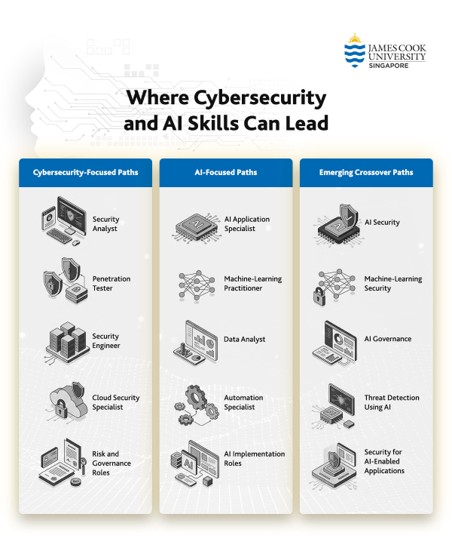
Cybersecurity graduates may work towards roles such as security analyst, penetration tester, security engineer, threat analyst, cloud security specialist or security consultant. Opportunities also exist in risk management, governance, compliance and security strategy.
AI graduates may pursue work involving machine learning, data analysis, intelligent applications, automation or AI implementation. The precise role will depend on their technical depth, previous qualifications and industry experience.
The overlap between the fields can also lead towards emerging areas such as:
- Securing machine-learning systems
- Using AI for threat detection and response
- AI risk and governance
- Adversarial machine learning
- Security testing for AI-enabled applications
- Protecting the data used to train AI systems
Not every graduate will enter a highly specialised position immediately. Career outcomes depend on technical ability, project experience, professional certifications, communication skills and familiarity with the organisation or industry being protected.
Your Next Step: Explore Cybersecurity and AI Courses at JCU Singapore
Choosing between cybersecurity and AI does not have to mean closing the door on the other field. The better starting point is to decide whether you want a broad undergraduate foundation, advanced cybersecurity expertise or postgraduate specialisation in AI.
Explore Cybersecurity and AI Courses at JCU Singapore →
Frequently Asked Questions
What cybersecurity and AI courses does JCU Singapore offer?
JCU Singapore offers the Bachelor of Cybersecurity at the undergraduate level. At the postgraduate level, students can pursue the Master of Information Technology with a major in either Cybersecurity or Artificial Intelligence. Students who prefer a broader IT foundation can also consider the Bachelor of Information Technology, which covers Machine Learning, Data Mining and Deep Learning without a dedicated AI major. The Bachelor of Cybersecurity and Master of Information Technology are conditionally provisionally accredited by the Australian Computer Society (ACS), and the Bachelor of Information Technology is conditionally accredited by ACS.
Should I study cybersecurity or AI?
Cybersecurity may suit you if you are interested in protecting systems, investigating threats and managing digital risk. AI may be a better fit if you want to work with data, machine learning, automation and intelligent systems across different industries. The fields increasingly overlap, so studying one can also provide opportunities to develop skills relevant to the other.
How is AI used in cybersecurity?
AI can help cybersecurity teams detect unusual activity, prioritise alerts, analyse large amounts of security data and automate routine tasks. However, it can also be used by attackers to scale malicious activity or create more convincing threats. AI generally supports the work of cybersecurity professionals rather than replacing the need for security expertise and human judgement.
What does the Master of Information Technology (Majoring in Artificial Intelligence) at JCU Singapore cover?
The course prepares students to explore how AI can be applied across areas such as business, healthcare and technology. The Artificial Intelligence major includes subjects in Deep Learning, Data Mining, Large Language Models, and AI Applications and Ethics. The course is composed of 16 subjects, including foundation, core, major and elective components.
Do cybersecurity jobs require AI skills?
Not every cybersecurity role requires advanced AI or machine-learning expertise. However, AI literacy can be valuable as organisations increasingly use automated tools for threat detection, analysis and response. Cybersecurity professionals who understand both security principles and AI systems may also be suited to emerging areas such as AI governance, machine-learning security and the protection of AI-enabled applications.