Media Releases
JCU in Singapore HDR candidates make their mark at Open Access Advocate Awards 2025
Media Releases
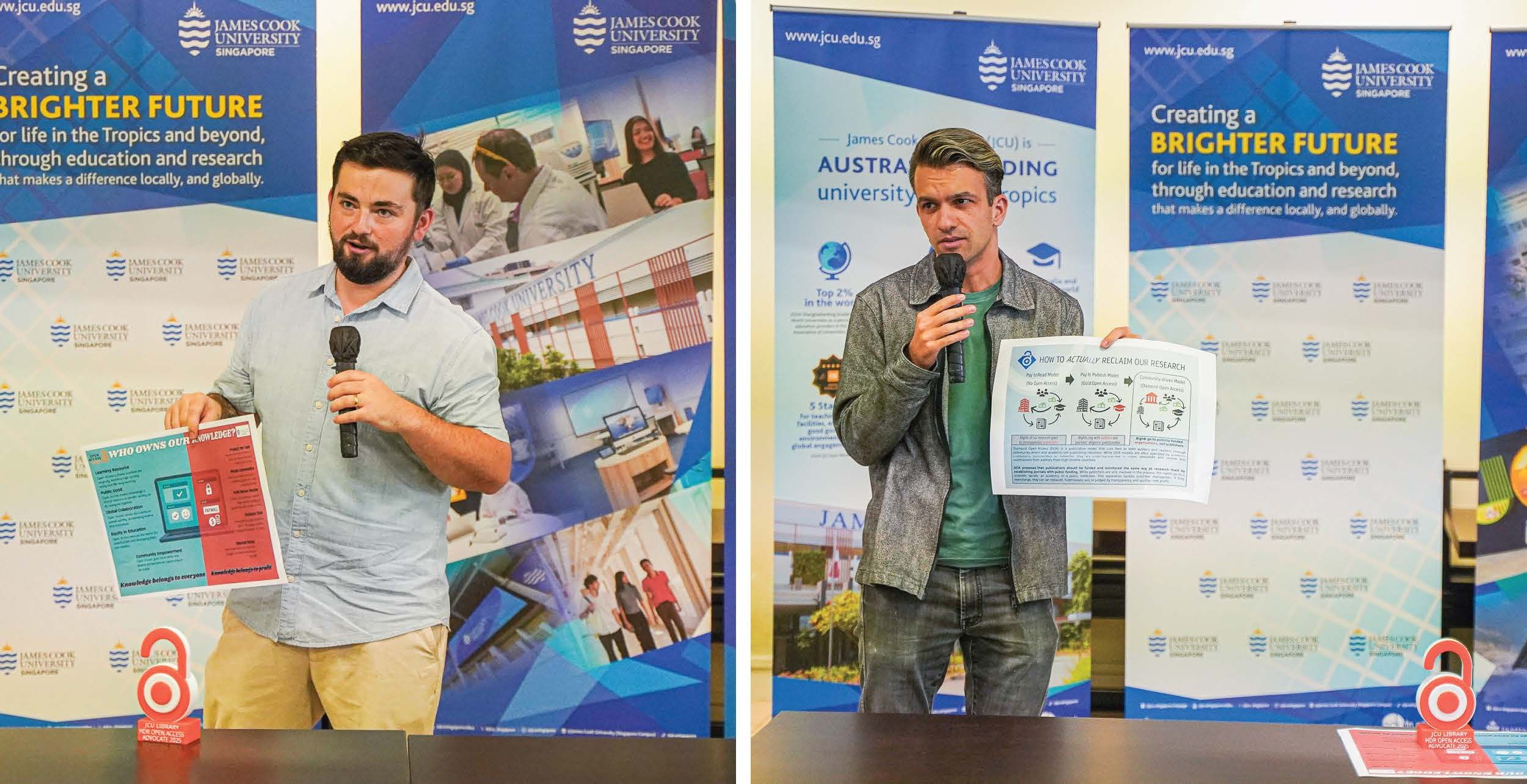
How can communities today reassert control over the knowledge they produce? During Open Access Week 2025, two HDR candidates (students pursuing advanced, research-based degrees such as a PhD) from JCU in Singapore were recognised at JCU’s university-wide Higher Degree by Research Open Access Advocate competition for addressing this topic with their presentations. The competition is annually organised by JCU Library in collaboration with the Graduate Research School.
Imagine a world where knowledge is accessible to everyone. This could be done with open access in research – a practice that seeks to remove barriers such as paywalls to academic information. It ensures that anyone, regardless of their background, can access and benefit from scholarly knowledge. This encourages collaboration, accelerates discovery, and ensures that valuable research is shared for the greater good.
On 21 October, two Higher Degree by Research (HDR) candidates from the Singapore campus of James Cook University (JCU in Singapore) were recognised for their submissions to the 2025 HDR Open Access Advocate competition – Doctor of Philosophy (Health) candidate Riley Dimech was announced as winner, and Doctor of Philosophy (Society and Culture) candidate Robin Weber received one of two highly “Highly Commended” awards.
Hosted annually by the JCU Library in collaboration with the Graduate Research School (GRS), the competition commemorates Open Access Week 2025, which this year was held from 20 to 26 October 2025. This year’s theme, “Who Owns Our Knowledge?” sought to encourage a candid conversation about which approaches to open scholarship prioritised the best interests of the public and the academic community. Participants were required to produce a poster, similar to one they might present at a conference, to respond to the theme question.
Riley’s poster, titled “Who Owns Our Research?” highlighted that knowledge ultimately belongs to everyone, regardless of background, affiliation or means. By comparing open access and traditional closed access systems side by side, he aimed to reveal their contrasting effects on the research ecosystem.
“My inspiration came from the belief that scholarship should be a catalyst for universal progress; the pursuit of knowledge is most meaningful when it is shared openly and collaboratively,” he said.
“Open Access empowers academics, lifelong learners, educators, and communities, who rely on freely available knowledge to grow and create change. As an HDR candidate at JCU in Singapore, I recognise the privilege of access that comes with institutional affiliation, and I feel a responsibility to advocate for levelling that playing field,” he added.
Robin’s poster, entitled “How to Actually Reclaim Our Research”, explored open access by depicting different paths to publishing and accessing research articles – Pay-to-Read Model (No Open Access), Pay-to-Publish-Model (Gold Open Access), and Community-Driven Model (Diamond Open Access). As such, Robin stressed that while there are improvements in the current Open Access Model, some shortcomings persist. He advocated for the Diamond Open Access model – a community-driven model that cuts fees for both authors and readers through community-driven and academic-led publishing initiatives. His presentation shows how Diamond Open Access can tackle publisher monopolies and ensure that submissions will be judged on transparency and quality instead of profit.
“I highlight the Diamond Open Access model because it's a relatively new model which is not yet very well known. The idea to reshape the money flow in the publishing process and introducing public institutions in the model offers a solution to the current issues in open access,” he said.
“I hope that the discussion about other ways of practicing open access can raise awareness of the problems the initiative is having. While it is important to celebrate the current efforts as an improvement over closed access, I think it is equally necessary to be aware of its imperfections in order to advance these efforts,” he added.
JCU has long been a strong advocate of open access, recognising that research should serve communities and drive positive change. Besides hosting open access initiatives annually, it has established its institutional repository ResearchOnline@JCU to make staff and HDR research outputs freely available, and signed 19 Read and Publish agreements to remove barriers to open publishing.“It’s always great to see our Singapore candidates stepping up for these events and demonstrating their enthusiastic engagement for issues that matter. Knowledge ownership becomes increasingly contested due to ethical considerations and power dynamics, while knowledge itself is being redefined. It’s important that our candidates acknowledge these tensions through various means, and the Open Access Advocate competition is a way to exercise their creativity and persuasion,” said Associate Professor Denise Dillon, Associate Dean Research Education at JCU in Singapore. Read about all the JCU Open Access Week 2025 Awards here: https://jculibrarynews.blogspot.com/2025/10/open-access-week-awards-2025-jcu-library.html
Find out more about the Singapore campus of James Cook University.
Discover further information on areas of research, and research strength at James Cook University in Singapore.
Contacts
Research: Associate Professor Denise Dillon denise.dillon@jcu.edu.au
Media: Ms Pinky Sibal pinky.sibal@jcu.edu.au / Ms Hoe Shu Rin shurin.hoe@jcu.edu.au