Media Releases
JCU in Singapore launches nation’s first university-based Asian seabass broodstock and hatchery facility
Media Releases
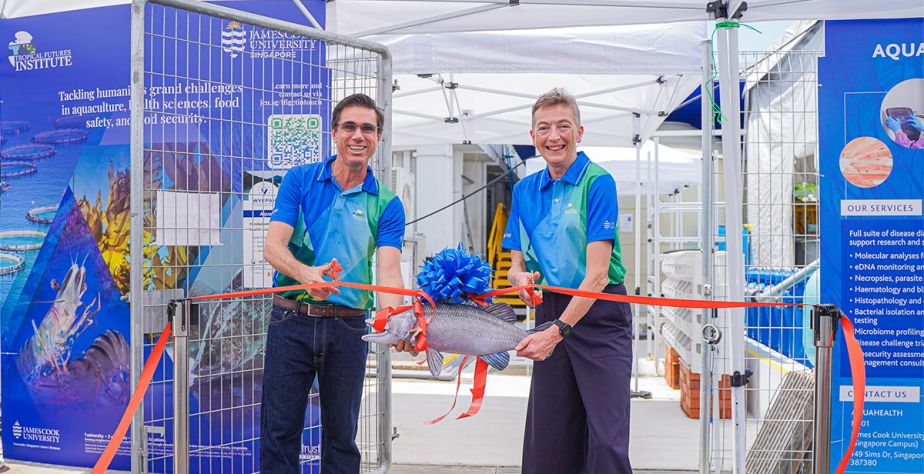
The new purpose-built facility will advance tropical aquaculture research, industry innovation and workforce development in support of Singapore’s food resilience.
The Singapore campus of James Cook University (JCU) has launched Singapore’s first university-based Asian seabass broodstock and hatchery facility, creating a dedicated platform for teaching, research and industry collaboration in sustainable tropical aquaculture.
The new Broodstock and Larviculture Facility will strengthen Singapore’s capabilities in tropical marine food-fish broodstock management, reproduction, genetics, nutrition, aquatic animal health and sustainable hatchery production technologies.
The facility will initially hold Asian seabass, also known as barramundi(Lates calcarifer), one of the region’s most commercially important marine fish species and a popular food fish in Singapore. Widely farmed across Singapore, Southeast Asia and Australia, the species provides a valuable model for research and training with regional and industry relevance.
Advancing aquaculture research and innovation
Together with JCU’s existing Aquaculture Teaching and Research Facility, which incorporates an aqua-feed mill, AquaHealth Laboratory and Food Safety Laboratory, the new facility creates an integrated, multidisciplinary research platform spanning the aquaculture value chain – from broodstock and fingerling production to feed development, aquatic animal health and seafood safety.
“This facility fills an important gap in university-based aquaculture infrastructure by providing Singapore with a dedicated tertiary platform for teaching and research in tropical marine fish hatchery science,” said Distinguished Professor Dean Jerry, Director of the Tropical Futures Institute (TFI) at JCU.
The purpose-built recirculating aquaculture system (RAS) was designed by JCU researchers and draws on more than two decades of expertise from JCU Australia’s internationally recognised aquaculture research programme. Programmable temperature and lighting controls enable researchers to maintain precise conditions for ensuring optimal fish breeding. The facility will also provide a reliable year-round supply of seabass larvae and juvenile fish, addressing a longstanding challenge for hatchery-based studies and the training of future aquaculture practitioners in the region.
Nurturing the next generation of aquaculture experts
The facility will allow students enrolled at JCU’s Bachelor of Science (Majoring in Aquaculture Science and Technology) and Bachelor of Business and Environmental Science (Majoring in Aquaculture), as well as postgraduate Master's and PhD programmes, to gain real-life hands-on experience in broodstock management, spawning, hatchery operations and larval rearing. These practical skills are increasingly important across the aquaculture industry, where employers require graduates who can apply scientific knowledge in real production environments.
“The facility will equip graduates with practical skills in hatchery operations and broodstock management, enabling them to contribute directly to Singapore’s aquaculture sector,” said Professor Jose Domingos, Deputy Director of the Tropical Futures Institute (TFI) at JCU.
“It will also support industry-led research to improve seabass breeding performance, fish health, hatchery productivity and seedstock quality.”
Students will benefit from undergraduate and postgraduate research projects, internships and collaborative industry partnerships, creating opportunities to work alongside researchers and aquaculture companies toaddress real production challenges and evaluate emerging technologies before they are adopted commercially.
“Universities play an important role in developing solutions to complex global challenges such as food security,” said Professor Carole-Anne Upton, Deputy Vice-Chancellor, Singapore, James Cook University. “This facility reflects our commitment to providing researchers, students and industry partners with the infrastructure needed to advance sustainable aquaculture, while developing the talent and innovations that will benefit Singapore and the wider region.”
The facility was developed by JCU with partial funding support from the Singapore Food Agency (SFA) through the Singapore Food Story R&D Programme 1.0. It was established in connection with a research project undertaken in collaboration with Barramundi Group, UVAXX and Republic Polytechnic.
The launch was attended by representatives from SFA, industry partners, research collaborators and members of the University’s academic community, recognising the collective effort behind the facility’s development and its role in strengthening Singapore’s aquaculture ecosystem.
Future Plans
In the short term, the facility will establish a sustainable Asian seabass broodstock population while supporting teaching, collaborative research and industry engagement.
Future research will include selective breeding, genomics, fish reproduction, nutrition, aquatic animal health, precision aquaculture and sustainable hatchery technologies. The facility will also provide a platform for industry and government collaboration to improve the productivity, sustainability and resilience of tropical aquaculture in Singapore and across the Indo-Pacific.
Discover further information on areas of research, and research strength at James Cook University in Singapore.
Find out more about the Singapore campus of James Cook University.
Contacts
Media: Ms Kumudha Panneerchelvam kumudha.panneerchelvam@jcu.edu.au / Ms Hoe Shu Rin shurin.hoe@jcu.edu.au