Psychology offers a strong foundation in understanding how people think, feel, and behave. In Singapore, this knowledge is applied across healthcare, education, business, public policy, and technology. Whether your interests lie in mental wellbeing, organisational development, research, consumer behaviour, or community work, a psychology degree can lead to rewarding, people-centred careers.
Quick Answer
Psychology graduates in Singapore can pursue careers across different areas, including mental health, human resources and organisational development, research and data analysis, and marketing and consumer behaviour. Entry-level roles are accessible with a bachelor's degree, while becoming a registered psychologist in Singapore typically requires a postgraduate degree. Singapore's growing focus on mental well-being, evidence-based policy, and behavioural insight in business has broadened demand for psychology graduates significantly.
Summary Overview
A psychology degree equips you with scientific research skills, data literacy, and a deep understanding of human behaviour — competencies in demand across sectors in Singapore, from mental health, to HR, marketing, and policy research.
- Psychology graduates pursue roles across healthcare, HR, research, marketing, education, and social services.
- Transferable skills — data analysis, critical thinking, communication, empathy — are valued across industries.
- To become a registered psychologist in Singapore, requirements typically include a two-year professional Master degree in psychology with supervised practicum.
- Singapore's growing focus on mental well-being and evidence-based policy is expanding career opportunities.
- Applied, practice-ready learning at JCU Singapore helps translate theory into workplace-ready capabilities.
Why Study Psychology?
Psychology trains you to investigate human behaviour using scientific methods and apply evidence to solve real-world problems. You will study cognitive and social psychology, mental health and wellbeing, and research design and statistics — while building communication and critical thinking skills that cut across nearly every profession.
These capabilities help you interpret complex information, collaborate with diverse groups, and make informed decisions using your knowledge of human behaviour— from hospitals and schools to corporations and government agencies.
Did you know? Singapore has made significant investments in mental health infrastructure through the National Mental Health Blueprint, increasing demand for professionals who understand psychology at every level of service delivery.
Is There Demand for Psychology Graduates in Singapore?
Demand is strong across multiple sectors. Growing awareness of mental well-being in schools and workplaces, the expansion of community mental health services, and the increased use of behavioural insights in business and public policy have all expanded opportunities. The market spans from entry-level research to advanced clinical practice, organisational consulting, and academic positions.
Jobs You Can Get with a Psychology Degree in Singapore
The following career pathways represent the most active areas of employment for psychology graduates in Singapore.
Field | Roles |
|---|---|
Mental Health & Clinical Psychology | Mental health support worker, research assistant |
Human Resources & OD | HR specialist, talent development consultant, people scientist, L&D executive |
Research & Data Analysis | Behavioural researcher, research assistant, policy analyst |
Marketing & Consumer Behaviour | Market research analyst, UX researcher, consumer behaviour specialist |
Social Services & Community Work | Case worker, youth worker, programme coordinator |
Education & Community Well-being | Student well-being coordinator, assistant roles |
A Closer Look at Key Career Pathways
1. Mental Health & Clinical Psychology
Entry-level roles, such as mental health support worker, are accessible with a bachelor's degree within community agencies, schools, and social service organisations. To pursue a psychologist role in Singapore, you will need to pursue a postgraduate qualification and register with the Singapore Register of Psychologists (SRP). Demand continues to grow as Singapore expands mental health services across schools, workplaces, and community settings.
2. Human Resources, People Analytics & Organisational Psychology
Roles include HR specialist, talent development consultant, learning and development executive, and people scientist. Graduates combining psychology training with data literacy are especially well-positioned in Singapore's corporate landscape, particularly in HR technology and people analytics firms.
3. Research, Data Analysis & Policy
Government agencies, healthcare institutions, and research firms recruit psychology graduates for research assistant, policy analyst, and behavioural insights specialist roles. These positions leverage statistical tools, experimental design expertise, and scientific reasoning. Singapore's emphasis on evidence-based policy makes this pathway particularly well-supported at the national level.
4. Marketing, UX Research & Consumer Behaviour
Roles such as UX researcher, market research analyst, and consumer behaviour specialist draw directly on cognitive psychology, motivation theory, and research methodology. Singapore's tech and digital marketing sectors actively employ psychology-trained professionals, with research method skills.
5. Social Services & Community Work
Voluntary welfare organisations, public sector bodies, and social service agencies recruit for case management, youth work, and family support roles. Graduates often progress into supervisory positions with experience and may pursue additional qualifications in social work or counselling to deepen their practice.
6. Education & Student Well-being
Psychology graduates can pursue roles such as student well-being coordinators in school settings. Developmental and educational psychology knowledge is consistently in demand across Singapore's schools and early childhood sector.
Psychology Career Pathway Overview
Career Area | Entry-Level Roles | Advanced Roles | Typical Qualification |
|---|---|---|---|
Mental Health | Support Worker, Associate Psychologist | Clinical Psychologist | Entry-level roles: Bachelor's Advanced roles: Masters |
Human Resources | HR Executive, L&D Coordinator | People Scientist, OD Consultant | Bachelor's (Master's advantageous) |
Research & Policy | Research Assistant, Policy Analyst | Research Fellow, Behavioural Insights Lead | Entry-level roles: Bachelor's Advanced roles: Masters |
Marketing & UX | Market Research Executive, UX Researcher | Consumer Insights Manager, UX Research Lead | Bachelor's (portfolio important) |
Social Services | Case Worker, Youth Worker | Programme Manager, Senior Case Manager | Bachelor's (social work cert. valued) |
Education | Educational Therapist | Student Wellbeing Head, Educational Psychologist | Bachelor's + postgraduate specialisation |
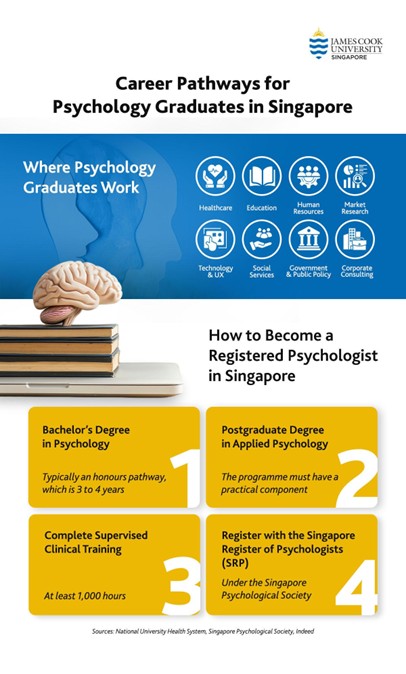
Sources: National University Health System, Singapore Psychological Society, Indeed
Skills You Gain from a Psychology Degree
Beyond discipline-specific knowledge, a psychology degree develops core transferable skills valued by employers across industries:
- Critical thinking — evaluating evidence and forming reasoned conclusions
- Research & statistics — designing studies and interpreting quantitative and qualitative data
- Communication & empathy — engaging with diverse individuals and presenting findings clearly
- Data analysis — using tools and methods to derive insights from complex datasets
- Ethical reasoning — navigating sensitive situations with professional integrity
- Behavioural insight — understanding how and why people think, feel, and act
- Report writing — communicating findings in structured, professional formats
- Cross-cultural competence — working effectively across multicultural contexts
Studying Psychology at JCU Singapore
JCU Singapore offers psychology programmes spanning biological, cognitive, developmental, and social psychology alongside research methods and ethics. Teaching integrates laboratory classes, case studies, and supervised projects. Career preparation is built into the curriculum through modules developing professional communication, teamwork, and reflective practice — helping you apply psychological knowledge in workplace contexts from day one.
Psychology Programmes at JCU Singapore
- All Psychology Courses — Undergraduate & Postgraduate
- Bachelor of Psychological Science
- Bachelor of Psychological Science (Honours)
- Bachelor of Arts (Majoring in Psychology Studies)
- Diploma of Higher Education (Majoring in Psychological Science)
- Master of Psychology (Clinical)
- Master of Psychological Science (Business Psychology)
- Graduate Certificate of Psychological Science
- Graduate Diploma of Psychology
If you plan to practice in Australia, make sure the course is accredited by the Australian Psychology Accreditation Council (APAC). Students who finish an APAC-accredited four-year psychology program along with an accredited Master’s degree can become members of the Australian Psychological Society (APS) and are eligible to apply for registration as psychologists in Australia. To learn more about the pathways to becoming a registered psychologist in Australia, visit the APAC website.
JCU Singapore offers APAC-accredited courses, including the Bachelor of Psychological Science, Bachelor of Psychological Science (Honours), and Graduate Diploma of Psychology.
Is a Psychology Degree Right for You?
Psychology suits those who are curious about behaviour, care about mental wellbeing, enjoy research and analysis, and want to make evidence-informed contributions to people-centred fields. It is a good fit if you are both analytical and empathetic — comfortable working with data and motivated to improve outcomes for individuals and communities.
Ready to Build Your Psychology Career?
Explore JCU Singapore's undergraduate and postgraduate psychology programmes — designed to prepare you for the full range of careers where understanding people makes a difference.
Visit: https://www.jcu.edu.sg/
Frequently Asked Questions
Q1: What jobs can you get with a psychology degree in Singapore? |
Psychology graduates can pursue careers in mental health, human resources, research and data analysis, marketing and consumer behaviour, social services, and education. Demand spans Singapore's public and private sectors. |
Q2: Is psychology in demand in Singapore? |
Yes. Demand is growing across mental health services, HR, education, social services, and corporate wellness. Singapore's national focus on mental well-being and evidence-based policy has significantly broadened career opportunities for psychology graduates. |
Q3: How much do psychology graduates earn in Singapore? |
Entry-level roles typically start between SGD 2,200 and SGD 3,500 per month. Mid-career psychologists with a Master's degree can earn between SGD 6,500 and SGD 8,000 per month. HR, UX research, and consumer insights roles may offer comparable or higher salaries. |
Q4: Do I need a postgraduate degree to work as a psychologist in Singapore? |
To practise as a psychologist, you generally need a professional psychology postgraduate degree (Master’s or Doctorate), and at least 1,000 hours of supervised practicum to be registered in the Singapore Register of Psychologists (SRP) under the Singapore Psychological Society. An undergraduate degree opens many related roles, but clinical registration requires a postgraduate degree. |
Q5: What industries hire psychology graduates in Singapore? |
Psychology graduates are hired across healthcare, education, HR, corporate consulting, market research, social services, the Singapore civil service, and technology companies. |
Q6: Can psychology graduates work in business or tech in Singapore? |
Yes. Psychology graduates are well-suited to HR, organisational development, UX research, consumer insights, and people analytics roles within business and technology companies. Singapore's tech and startup ecosystem actively employs psychology-trained professionals. |
Q7: What is business psychology and can I study it in Singapore? |
Business psychology applies psychological principles to workplace behaviour, leadership, and organisational performance. JCU Singapore offers the Master of Psychological Science (Majoring in Business Psychology) for graduates seeking careers at the intersection of people and organisations. |
Q8: How long does it take to become a psychologist in Singapore? |
Typically a three or four-year undergraduate degree followed by a two-year Master's programme and supervised practice hours (Note: Number of hours varies depending on university requirements). To be registered with the Singapore Register of Psychologists (SRP), you’ll need at least 1,000 supervised practicum hours. At JCU Singapore, the undergraduate degree takes three years with the Honours programme or graduate diploma in psychology. As such, the full journey to becoming a registered psychologist takes a minimum of five to six years depending on specialisation. |
Q9: What transferable skills does a psychology degree give you? |
Key skills include critical thinking, data analysis, research design, communication, empathy, ethical reasoning, and interpreting complex human behaviour — applicable across many industries beyond clinical practice. |
Q10: Is JCU Singapore's psychology degree recognised in Australia? |
JCU Singapore is a campus of James Cook University, a globally ranked Australian university. Its psychology programmes follow the same curriculum and quality standards as those in Australia. JCU Singapore’s Bachelor of Psychological Science, Bachelor of Psychological Science (Honours), and Graduate Diploma of Psychology are accredited by the Australian Psychology Accreditation Council (APAC). |
Conclusion
A psychology degree opens diverse career pathways across healthcare, business, research, marketing, education, and social services in Singapore. By building analytical, interpersonal, and research skills, it prepares you for roles that require both scientific rigour and a deep understanding of people.
For anyone asking what psychology degree jobs in Singapore look like in practice, the pathway ranges from entry-level positions to advanced clinical, research, and organisational practice. Explore JCU Singapore's psychology programmes to take the first step towards a career that puts people at its centre.
Sources (for reference only)
Career Pathways & Job Market
- Mental Health — Singapore Psychological Society — Careers in Psychology — https://singaporepsychologicalsociety.org/resources/who-are-psychologists/careers-in-psychology/
- HR, Research & Organisational Psychology — Singapore Psychological Society — Who Are Psychologists? — https://singaporepsychologicalsociety.org/resources/who-are-psychologists/
- Social Services (Clinical, Counselling & Educational Psychology) — National Council of Social Service (Singapore Government) — https://www.ncss.gov.sg/careers/social-service-careers/roles-in-social-services/psychology
- All Six Pathways (Mental Health, HR, Research, Marketing, Social Services, Education) — Indeed Singapore — What Can You Do with a Psychology Degree? — https://sg.indeed.com/career-advice/finding-a-job/what-can-i-do-with-a-psychology-degree
- American Psychological Association — Psychology Career Guide — https://www.apa.org/education-career/guide/careers
- Psychology Careers Overview (Singapore edition) —Psychology Today Singapore — https://www.psychologytoday.com/sg/basics/psych-careers
Salary Data
- FY2025 Skills and Salary Guidelines for the Social Service Sector (MSF/NCSS, effective April 2025) — https://file.go.gov.sg/salary2025.pdf
- Ministry of Manpower (MOM) Singapore — Occupational Wages Tables 2024 — https://stats.mom.gov.sg/Pages/Occupational-Wages-Tables2024.aspx
Psychologist Registration Requirements
- Singapore Psychological Society (SPS) — Singapore Register of Psychologists (SRP) — https://singaporepsychologicalsociety.org/srp_membership/srp/
- Singapore Psychological Society (SPS) — SRP Application Criteria & Form — https://singaporepsychologicalsociety.org/wp-content/uploads/2017/06/SRP-Application-Form.pdf
- Singapore Psychological Society (SPS) — SPS FAQs — https://singaporepsychologicalsociety.org/join-sps/sps-faqs/
Mental Health Landscape & Demand in Singapore
- Ministry of Health (MOH) Singapore — National Mental Health and Well-being Strategy (2023) — https://www.moh.gov.sg/others/resources-and-statistics/national-mental-health-and-well-being-strategy--2023-/
- Ministry of Health (MOH) Singapore — Community Mental Health Masterplan & National Mental Health Blueprint — https://www.moh.gov.sg/newsroom/community-mental-health-masterplan-and-national-mental-health-blueprint/
Australian Accreditation
- Australian Psychology Accreditation Council (APAC) — https://www.psychologycouncil.org.au/